 +91 88281
11034
+91 88281
11034
 Need Help?




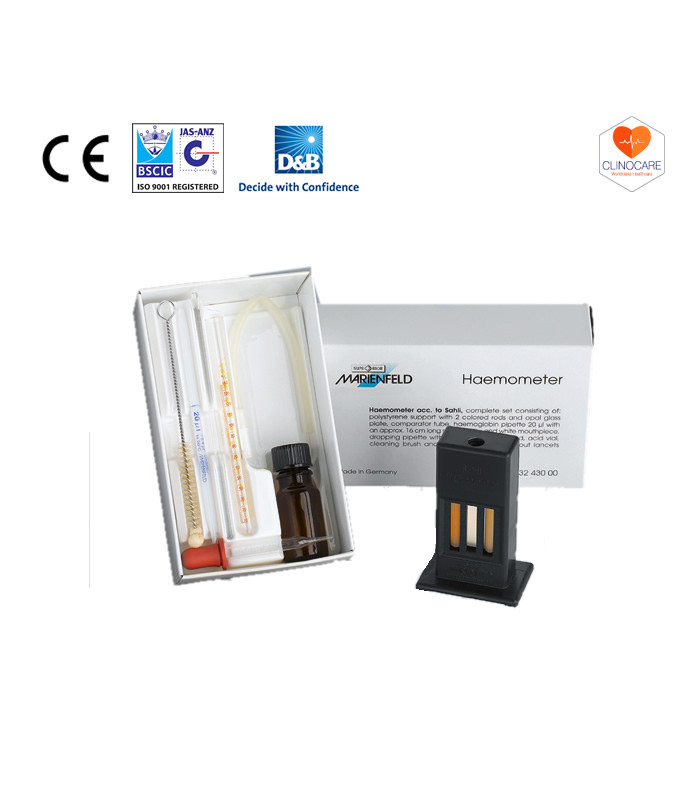
Haemometer with Round Tube
Drug Name
: NA
Drug Role
: Haemoglobin Measurement
NA
No
Ceritifcations:










Please login / register to buy or to get detailed information of the product
SKU:
Stock Available:
Batch / Lot. No:
Shelf life:
Manufacturing Date:
-
Expiry Date:
-
Minimum Pack Size:
Minimum Order Qty:
1
Pharma Categories:
Diagnostic & Laboratory Equipment
Product Form:
Haemometer with Round Tube
Category:
Instruments
Group:
N/A
Type:
Diagnostic Instrument
Material:
SS
Tags
HSN Code:
9018
HS Code:
901819
Country of Origin:
India
TAX:
5%
Qty per Piece:
Weight Of Each Piece(gm):
Piece Dimensions (L×W×H):
Qty per Buffer Box / Shrink Pack:
Weight of Buffer Box / Shrink Pack:
Buffer Dimensions (L×W×H):
Total Qty per Case:
Total Weight per Case:
Case Dimensions (L×W×H):
Weight / Volume:
Dimensions:
Inhouse product
A haemometer with a round tube is a device used to measure the haemoglobin content in blood. It uses a calibrated glass tube and reagents to determine haemoglobin concentration in clinical and diagnostic labs.
• Material: Borosilicate glass tube
• Capacity: 5 ml or 10 ml typically
• Calibration: Graduated scale for haemoglobin levels
• Design: Round, smooth tube for accurate measurement
• Colour indicator: Paired with reagents for colorimetric comparison
• 5 ml (miniature size for paediatric or low volume testing)
• 10 ml (standard size for general use)
• Round tube design for smooth flow and easy handling
• Manual haemometer: Visual comparison with colour charts
• Semi-automatic haemometer: Photometric measurement with light sensors
• High-quality borosilicate glass for durability and chemical resistance
• Reagents typically include sodium lauryl sulphate and iron salts
• Medical diagnostic instruments
• Haemoglobin measurement devices
• Laboratory tools
Available individually or as part of a kit with reagents and instructions
Measures haemoglobin concentration by mixing blood with reagents and comparing the resulting colour to standards.
• Simple and cost-effective
• Quick results in minutes
• Portable for use in clinics and fieldwork
• Visual reading can be subjective
• Limited to haemoglobin testing only
• Requires careful handling and calibration
• Handle glass carefully to prevent breakage
• Use correct reagents to ensure accuracy
• Calibrate regularly and avoid contamination
• HSN 9018 : Medical and surgical instruments
• HSN 901819 : Hemoglobinometers and related devices
• Clean before and after use
• Store reagents in a cool, dry place
• Avoid direct skin or eye contact with reagents
• Clean with mild soap or alcohol-based solution
• Dry thoroughly before storage
• Autoclaving possible for non-chemical components
Used to check haemoglobin in animals to diagnose anaemia and blood conditions.
Useful in field and clinical settings for livestock and pets.
Used in hospitals and clinics to assess patient haemoglobin levels,
aiding anaemia diagnosis and health monitoring.
What is a haemometer with a round tube?
A device for measuring haemoglobin levels using a calibrated glass tube and reagents.
How does the round tube help?
Ensures smooth flow and precise measurement of blood and reagent mixtures.
How are results read?
By visual comparison to a colour chart or with a photometric sensor.
Can it be replaced by automated devices?
Yes, automated analysers offer faster, more accurate readings but at higher cost.
How often should it be calibrated?
Calibration should be done regularly, especially when reagents change or after long use.
Secure Transaction
100% secure payment
Top Brand
Trusted quality
Non Return
Due to hygiene