 +91 88281
11034
+91 88281
11034
 Need Help?


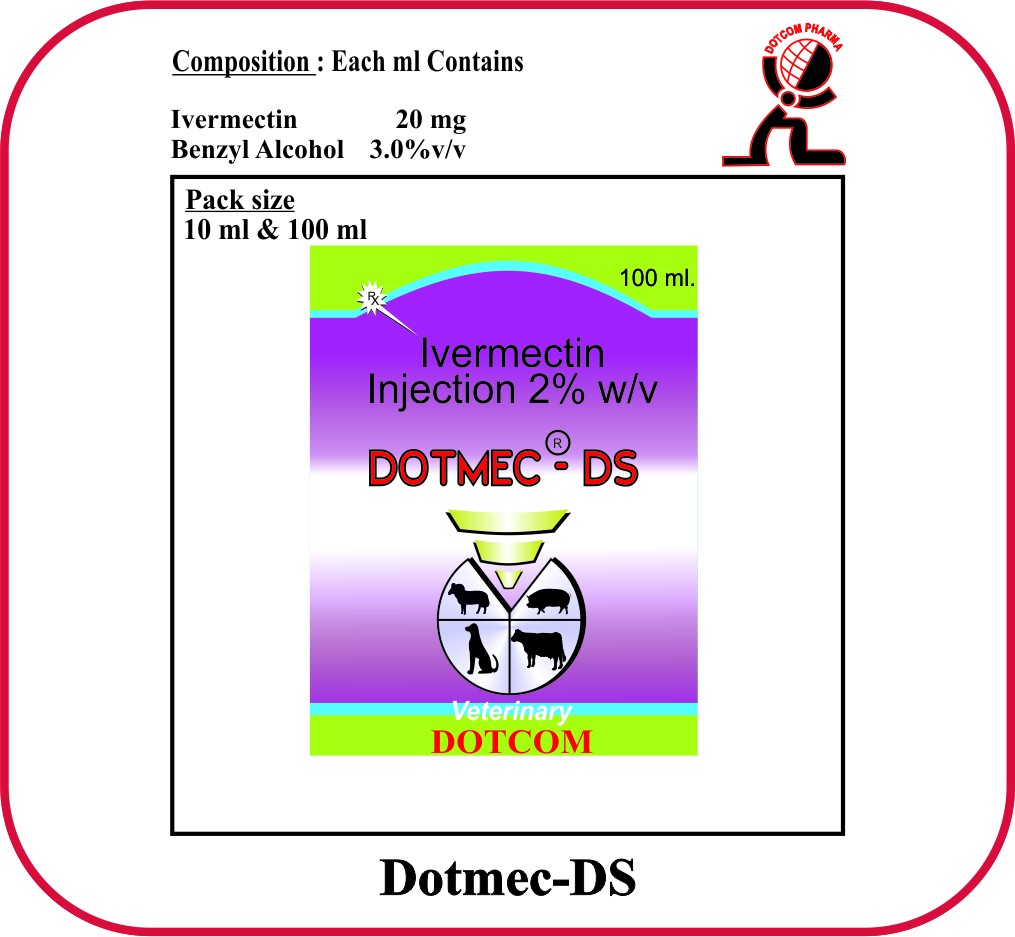
DOTMEC-DS
Drug Name
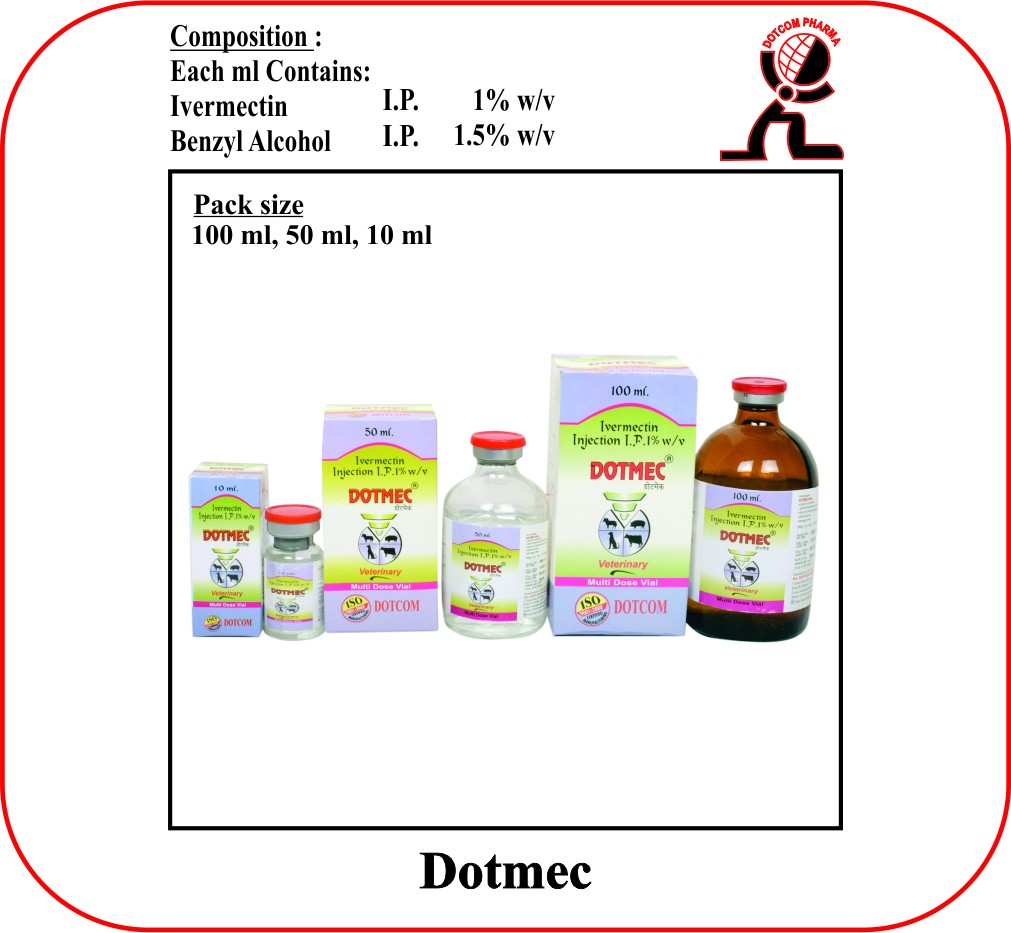
: Ivermectin-20 mg Injection for Veterinary Use
Drug Role
: Ivermectin is a broad-spectrum antiparasitic agent belonging to the ivermectin family.
NA
No
DOTCOM PHARMA
Ceritifcations:









Please login / register to buy or to get detailed information of the product
SKU:
Stock Available:
Batch / Lot. No:
Shelf life:
Manufacturing Date:
-
Expiry Date:
-
Minimum Pack Size:
Minimum Order Qty:
6
Product Form:
Sterile injectable solution supplied in amber glass vials in two sizes: • 10 ml vial (for small animals or precision dosing) • 100 ml vial (for larger herds or extended use)
Category:
Veterinary
Group:
N/A
Type:
Liquid Injection
Material:
Liquid
HSN Code:
3004
HS Code:
3004.90
Country of Origin:
India
TAX:
5%
Qty per Piece:
Weight Of Each Piece:
Piece Dimensions (L×W×H):
Qty per Buffer Box / Shrink Pack:
Weight of Buffer Box / Shrink Pack:
Buffer Dimensions (L×W×H):
Total Qty per Case:
Total Weight per Case:
Case Dimensions (L×W×H):
Weight / Volume:
Dimensions:
Inhouse product
Ivermectin is a broad-spectrum antiparasitic agent belonging to the ivermectin family. It is effective against a wide range of internal and external parasites in animals, including nematodes, arthropods, and certain ectoparasites. Ivermectin acts by binding selectively to glutamate-gated chloride ion channels in nerve and muscle cells of invertebrates, leading to paralysis and death of the parasites.
The product is formulated as a sterile injectable solution, available in amber glass vials of 10 ml and 100 ml, designed to ensure stability and protection from light.
• Active Ingredient: Ivermectin 20 mg per ml (equivalent to 2%)
• Excipients:
o Propylene glycol (solvent)
o Benzyl alcohol (preservative)
o Water for Injection (vehicle)
• pH adjusted for stability and compatibility with injection use
• Appearance: Clear, colourless to slightly yellow sterile solution
• Assay: Not less than 90% and not more than 110% of labelled ivermectin content
• Sterility: Must be sterile as per pharmacopeial standards (USP/BP)
• pH: 4.5 – 7.5
• Free from visible particulate matter
• Pyrogen-free as per regulatory guidelines
Ivermectin 20 mg injection is indicated for the treatment and control of:
• Gastrointestinal roundworms (nematodes)
• Lungworms (Dictyocaulus spp.)
• Warbles (Hypoderma spp.)
• Mange mites (Sarcoptes, Demodex)
• Lice infestations in cattle, sheep, goats, and swine
• Recommended dose: 0.2 mg ivermectin per kg body weight (equivalent to 1 ml per 100 kg) administered as a subcutaneous injection.
• Administration route: Subcutaneous (under the skin) injection only. Avoid intravenous or intramuscular routes.
• Dosage frequency: Single dose usually sufficient; consult veterinary advice for repeated treatment in heavy infestations.
Sterile injectable solution supplied in amber glass vials in two sizes:
• 10 ml vial (for small animals or precision dosing)
• 100 ml vial (for larger herds or extended use)
• Broad-spectrum efficacy against internal and external parasites
• Long-lasting effect with single dose administration
• Easy-to-use injection form with accurate dosing
• Minimal risk of resistance when used as directed
• Safe in a wide range of domestic animals
• Mild transient swelling or pain at the injection site may occur
• Rarely, neurological signs in sensitive breeds (e.g., certain dog breeds with MDR1 gene mutation)
• Overdose can cause tremors, ataxia, or coma—seek veterinary intervention immediately
• Meat and offal: Minimum 28 days before slaughter for human consumption
• Milk: Do not use in lactating animals producing milk for human consumption
• Follow local regulatory guidelines strictly
• For veterinary use only; not for human use
• Keep out of reach of children
• Use sterile needles and syringes for each injection to prevent contamination
• Avoid use in animals with known hypersensitivity to ivermectin or excipients
• Store away from direct sunlight and excessive heat
• Store at 15°C to 30°C (59°F to 86°F) in a dry place
• Protect from light by keeping in amber vial
• Do not freeze
• Keep vial tightly closed when not in use
• Wear protective gloves when handling to avoid skin contact
• In case of accidental human exposure, seek medical advice immediately
• Dispose of empty vials and syringes as per local biohazard regulations
• Avoid environmental contamination with unused product or packaging
• HS Code: 3004.90 (Medicaments consisting of mixed or unmixed products for therapeutic or prophylactic uses, put up in measured doses or in forms or packings for retail sale)
• HSN Code: 3004 (Medicaments consisting of mixed or unmixed products for therapeutic or prophylactic uses)
• Do not administer intravenously or intramuscularly; only subcutaneous route is safe and effective
• Always calculate dose carefully based on animal weight
• Avoid using ivermectin in aquatic animals as it is toxic to fish
• Monitor treated animals for adverse reactions for 24 hours post-injection
• Ivermectin is approved widely for veterinary use to control parasites in livestock and companion animals
• Human use ivermectin formulations exist but differ significantly in concentration and excipients—never substitute veterinary product for human use
• Veterinary ivermectin is vital for animal health, food safety, and parasite management programs
Q1: What is Ivermectin (IVM)?
A: Ivermectin is a broad-spectrum antiparasitic drug used in veterinary and human medicine to treat parasitic infections.
Q2: Can I use this ivermectin injection for pets like dogs and cats?
A: This formulation is primarily for livestock animals. Use veterinary-approved formulations specifically designed for pets, under veterinary supervision.
Q3: How soon after injection can animals return to grazing or milking?
A: Withdrawal period for meat is 28 days; avoid milking animals during treatment and follow local regulatory guidelines.
Q4: What if I overdose the animal?
A: Signs may include tremors, drooling, or lethargy. Contact a veterinarian immediately for supportive care.
Q5: Is ivermectin safe during pregnancy?
A: Use with caution; consult a veterinarian before administration in pregnant or lactating animals.
Q6: How should I store this product?
A: Store between 15-30°C in a dry, light-protected place, and avoid freezing.
Secure Transaction
100% secure payment
Top Brand
Trusted quality
Non Return
Due to hygiene