 +91 88281
11034
+91 88281
11034
 Need Help?




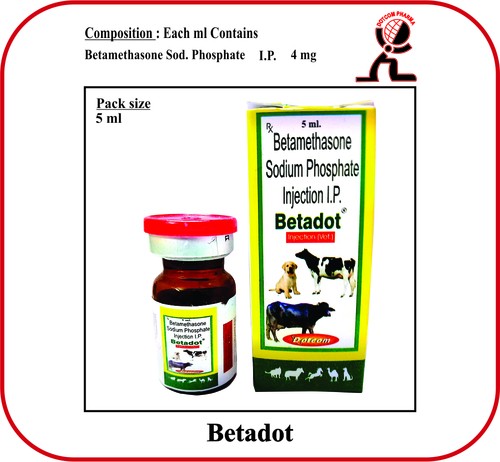
BETADOT
Drug Name
: Betamethasone Sodium Phosphate I.P. 4 mg Injection Sterile Injectable Solution – Veterinary Use Only
Drug Role
: Anti-inflammatory • Anti-allergic
NA
No
Ceritifcations:










Please login / register to buy or to get detailed information of the product
SKU:
Stock Available:
Batch / Lot. No:
Shelf life:
Manufacturing Date:
-
Expiry Date:
-
Minimum Pack Size:
Minimum Order Qty:
40
Pharma Categories:
• Corticosteroid • Anti-inflammatory • Immunosuppressive • Anti-allergic
Product Form:
• Sterile injectable solution • Packaging options: 5 mL vial
Category:
Liquid Injection
Group:
N/A
Type:
Liquid Injection
Material:
liquid
Tags
HSN Code:
3004
HS Code:
300432
Country of Origin:
India
TAX:
5%
Qty per Piece:
Weight Of Each Piece(gm):
Piece Dimensions (L×W×H):
Qty per Buffer Box / Shrink Pack:
Weight of Buffer Box / Shrink Pack:
Buffer Dimensions (L×W×H):
Total Qty per Case:
Total Weight per Case:
Case Dimensions (L×W×H):
Weight / Volume:
Dimensions:
Inhouse product
Betamethasone Sodium Phosphate is a fast-acting, water-soluble synthetic glucocorticoid corticosteroid. It possesses potent anti-inflammatory, anti-allergic, and immunosuppressive properties. It is rapidly absorbed following intramuscular or intravenous injection and provides quick relief in various acute and chronic inflammatory conditions affecting animals.
This injection is commonly used in the treatment of allergic reactions, arthritis, musculoskeletal conditions, shock, dermatitis, and respiratory diseases in livestock and companion animals.
• Formulation: Sterile aqueous injectable solution
• Active ingredient: Betamethasone Sodium Phosphate I.P. 4 mg per mL
• Appearance: Clear, colourless to slightly yellow solution
• pH: 7.0 – 8.5
• Sterility: Must comply with pharmacopeial standards
• Shelf Life: Typically 2 years under controlled storage
Each 1 mL contains:
• Betamethasone Sodium Phosphate IP: 4 mg
• Excipients:
o Water for Injection
o Buffering agents (e.g., sodium phosphate buffer)
o Preservatives (e.g., benzyl alcohol, if present, may vary by manufacturer)
• Water for Injection
• Buffering agents (to maintain pH)
• Preservatives (if present)
• Sodium chloride (for isotonicity)
• Corticosteroid
• Anti-inflammatory
• Immunosuppressive
• Anti-allergic
• Acute and chronic inflammatory conditions (arthritis, bursitis, synovitis)
• Allergic conditions (urticaria, dermatitis, insect bites)
• Shock (anaphylactic, traumatic)
• Respiratory conditions (asthma, bronchitis, pneumonia)
• Autoimmune and stress-related conditions in animals
• Parturition induction or fetal lung maturation in special cases (vet-advised)
Dosage should be individualized and based on the species, severity, and condition. Typical guideline doses:
• Cattle, horses, buffaloes: 10–20 mL IM or slow IV (equivalent to 40–80 mg)
• Sheep, goats: 2–5 mL
• Dogs, cats: 0.25–2 mL depending on size and indication
• Repeat only as per veterinary advice
• Intramuscular (IM)
• Intravenous (IV) slow injection
• Intra-articular (for joint inflammation, only by veterinary professionals)
• Sterile injectable solution
• Packaging options: 5 mL vial
Used across livestock, equines, canines, and felines for quick resolution of inflammation, pain, and allergic symptoms.
• Rapid anti-inflammatory action
• Water-soluble: quick onset and systemic availability
• Versatile: useful in a wide range of veterinary indications
• Reduces enema, swelling, and immune-mediated responses
• Convenient IM/IV administration
• Delayed wound healing
• Immunosuppression on prolonged use
• Increased susceptibility to infections
• GI ulceration or irritation (in some species)
• Polyuria, polydipsia, and appetite changes in dogs
• Iatrogenic Cushing’s syndrome with chronic overuse
• Hyperglycaemia (especially in diabetic animals)
• Prescription-only veterinary drug (Rx)
• Must be used under veterinary supervision
• Avoid prolonged use or high doses
• Use with caution in animals with diabetes, infections, or peptic ulcers
• Contraindicated in viral infections and fungal diseases unless life-saving
• Not to be used in late pregnancy unless advised by a vet
• Tapering may be needed to avoid adrenal suppression if used long-term
• Meat: 28 days
• Milk: 7 days (Always verify per country-specific regulatory authority)
• Store between 15°C – 30°C
• Protect from light and freezing
• Keep vial tightly sealed and use aseptically
• Use sterile syringes and needles
• Do not use if solution appears cloudy or contains particles
• Dispose safely as per local veterinary biomedical waste protocols
• HS Code: 3004909099
• HSN Code: 3004 (Medicaments consisting of mixed or unmixed products for therapeutic or prophylactic use)
• Do not mix with other injectables unless compatibility is established
• Observe animal closely after injection, especially during first use
• Veterinary follow-up is essential in chronic cases
• Strictly for veterinary use only
• Not intended or approved for human use
Q1: What is Betamethasone Sodium Phosphate used for in animals?
It is used to treat inflammation, allergic reactions, autoimmune diseases, and shock in veterinary species.
Q2: Is it fast-acting?
Yes, due to its water-solubility, it acts quickly after IM or IV administration.
Q3: Can it be given to pregnant animals?
Only if necessary and under strict veterinary supervision, as corticosteroids may affect pregnancy.
Q4: Are there side effects?
Yes, especially with long-term use—these may include immune suppression, delayed healing, and hormonal imbalance.
Q5: What are the withdrawal periods?
Meat: 28 days | Milk: 7 days (always confirm locally).
Q6: Can this injection be used with antibiotics?
Yes, if prescribed by a veterinarian. It is often co-administered with antibiotics during severe infections and inflammation.
Q7: Is there a risk of adrenal suppression?
Yes, with long-term or high-dose therapy, so dosage tapering is essential when discontinuing after extended use.
Secure Transaction
100% secure payment
Top Brand
Trusted quality
Non Return
Due to hygiene