 +91 88281
11034
+91 88281
11034
 Need Help?




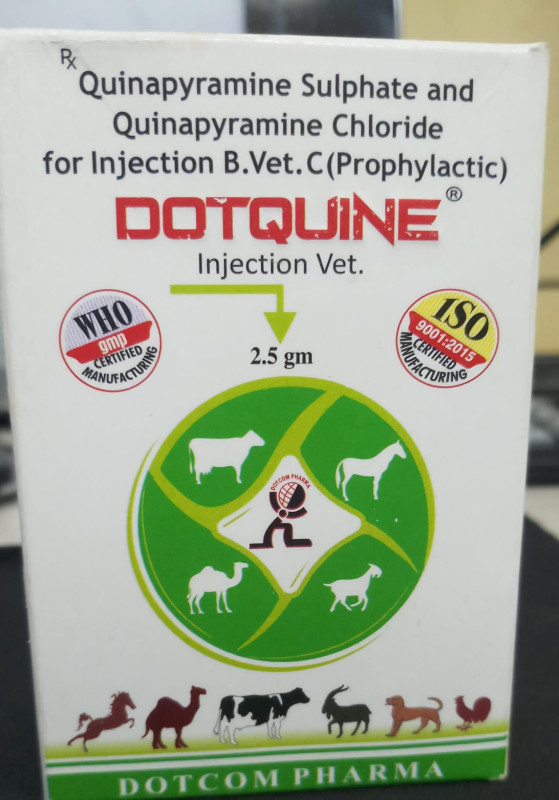
DOTQUINE
Drug Name
: Quinupramine Sulphate & Chloride Dry Injection Veterinary Use
Drug Role
: Antiprotozoal . Trypanocidal Agent
NA
No
Ceritifcations:









Please login / register to buy or to get detailed information of the product
SKU:
Stock Available:
Batch / Lot. No:
Shelf life:
Manufacturing Date:
Jan 2025
Expiry Date:
Dec 2026
Minimum Pack Size:
Minimum Order Qty:
10
Pharma Categories:
Antibiotic Dry Injection
Product Form:
Sterile Dry Powder For Injection
Category:
Dry Injection
Group:
N/A
Type:
Dry powder for injection
Material:
Dry powder
Tags
HSN Code:
3004.90.99
HS Code:
3004.90
Country of Origin:
India
TAX:
5%
Qty per Piece:
Weight Of Each Piece(gm):
Piece Dimensions (L×W×H):
Qty per Buffer Box / Shrink Pack:
Weight of Buffer Box / Shrink Pack:
Buffer Dimensions (L×W×H):
Total Qty per Case:
Total Weight per Case:
Case Dimensions (L×W×H):
Weight / Volume:
Dimensions:
Inhouse product
Quinupramine Sulphate and Quinupramine Chloride for Injection is a trypanocidal veterinary preparation used for the treatment and prophylaxis of trypanosomiasis in animals. This combination offers both curative and preventive effects due to the dual salt formulation:
• Quinupramine Sulphate: Primarily therapeutic (curative)
• Quinupramine Chloride: Preventive (prophylactic)
This long-acting formulation is specifically effective against Trypanosoma evansi and Trypanosoma brucei infections in large domestic animals such as cattle, buffaloes, camels, horses, donkeys, and dogs.
It acts by interfering with parasite nucleic acid synthesis and cell metabolism, leading to parasite death.
• Dosage Form: Sterile lyophilized powder for injection
• Appearance (Dry): Pale yellow to white crystalline powder
• Appearance (Reconstituted): Clear yellowish solution
• Solubility: Completely soluble in provided sterile water
• pH of Reconstituted Solution: 6.0 – 7.5
• Sterility: Must comply with B.Vet.C. standards
• Bacterial Endotoxins: Within specified veterinary pharmacopeial limits
• Assay: Each component 95%–105% of labelled claim
• Container Type: Type I glass vials with rubber stopper & aluminium seal
Each 2.5 gm vial contains:
• Quinupramine Sulphate B.Vet.C. – 1.5 gm
• Quinupramine Chloride B.Vet.C. – 1.0 gm
• Excipients – q.s.
• Sterile Water for Injection – Supplied separately in the pack (free)
• Therapeutic Class: Antiprotozoal / Trypanocidal Agent
• Mechanism of Action: Quinupramine disrupts protozoal DNA synthesis and metabolism, leading to inhibition of parasite replication and eventual death.
Indicated for prophylactic and therapeutic treatment of Trypanosomiasis caused by:
• Trypanosoma evansi (Surra)
• Trypanosoma brucei
• Trypanosoma equiperdum (in some regulatory areas)
Effective in:
• Horses
• Camels
• Cattle
• Buffaloes
• Donkeys
• Dogs (in endemic areas)
Route:
• Subcutaneous (S.C.) injection only
Recommended Dosage:
• 5–10 mg/kg body weight
• General guide:
o Large animals (e.g., camels, horses): 2.5 gm per 300–400 kg body weight
o Dogs: Dose adjusted proportionally under veterinary supervision
Frequency:
• Single administration provides both treatment and prophylaxis
• Repeat only under veterinary guidance based on regional epidemiology
Reconstitution:
• Dissolve entire content in provided sterile water
• Use immediately after preparation
• Form: Sterile dry powder for injection
• Pack Size: 2.5 gm (1 vial + 1 sterile water ampoule)
• Presentation:
o Vial with flip-off seal
o Sterile water ampoule for reconstitution
• Dual action: both curative and preventive
• Long duration of action against Trypanosoma spp.
• Fast therapeutic response in infected animals
• Effective in multiple species
• Easy single-dose regimen
• Local swelling or pain at injection site
• Nervousness or restlessness (transient)
• Hypersensitivity (rare)
• Overdose may lead to toxicity, particularly in dogs
• Do not administer intravenously
• Contraindicated in very young, weak, or debilitated animals
• Do not exceed the recommended dose
• Use with caution in dogs – highly sensitive species
• Avoid repeated or frequent use in non-infected animals
• Follow veterinary prescription strictly
• Meat: 28 days after administration
• Milk: Not for use in lactating animals producing milk for human consumption unless specified by local regulations
• Store in a cool, dry place below 25°C
• Protect from direct sunlight
• Do not freeze
• Use reconstituted solution immediately
• Dispose of unused portion safely
• Veterinary Use Only
• Prescription-only medicine
• Regulated under Schedule H (Veterinary) or equivalent
• Not to be used in animals intended for immediate slaughter unless withdrawal periods are observed
• HS Code (International): 3004.90 – Other medicaments for veterinary use
• HSN Code (India): 3004.90.99 – Veterinary medicines not elsewhere specified
• Ensure proper diagnosis of Trypanosomiasis before use
• Use aseptic technique for injection
• Do not use in animals showing nervous signs or weakness
• Always use under veterinary supervision
• Avoid using during extreme stress or dehydration
Q1: What is Quinupramine used for?
A: Quinupramine is used for the treatment and prevention of trypanosomiasis, a protozoal infection affecting livestock and working animals.
Q2: What’s the difference between the Sulphate and Chloride salts?
A: The Sulphate form is mainly therapeutic, while the Chloride form provides prophylactic protection — together they provide complete protection.
Q3: Can this be used in lactating animals?
A: It is not recommended unless clearly advised by a veterinarian due to potential residues in milk.
Q4: Is this injection safe for dogs?
A: Use with caution. Dogs are more sensitive and should only be treated under strict veterinary guidance with adjusted dosing.
Q5: How long does the protection last?
A: The prophylactic effect can last several weeks depending on species and infection pressure in the environment.
Q6: Can I repeat the dose weekly?
A: No. Frequent dosing increases risk of side effects and resistance. Use only as prescribed by a veterinarian.
Secure Transaction
100% secure payment
Top Brand
Trusted quality
Non Return
Due to hygiene